

Archaeological Items in the Alūksne Region in the 18th–19th Centuries
11.09.2026
Greetings! Over time, our museum has accumulated a great many "little things", as I call them – information which does not yield enough data, or is too speculative to form the basis of a major publication. In the blog "Untold Alūksne", we’ll try to tell you about some of these little mysteries of our town and district.
The very first topic is one that isn’t even easy to put a name to, but if I had to come up with a title, I’d say this: the search for material evidence of prehistory in the Alūksne region prior to the 20th century. It’s a tricky title – not quite ‘archaeology’ per se, yet at the same time a subject closely linked to archaeology. It must be assumed that all the artefacts described have since been lost, and the remaining descriptions of these artefacts (and, thanks to Mr J. Aspelin - the drawings!) are an invaluable source for research into the ancient material culture of our region.
- Ernests, historian of the Alūksne Museum.
The origins of artefactual research in Latvia date back to well before the country’s independence. Like elsewhere in Europe, the nobility and the wealthiest citizens were already collecting antiquities as early as the 16th and 17th centuries, the practice itself possibly originating with late medieval erudite circles. From the first half of the 18th century, when the first excavations in search of material evidence were carried out in Pompeii and Herculaneum, the potential for systematic excavations began to become apparent to historians as well, and during the 19th century, the modern science of archaeology gradually began to take shape. The writer and parish clerk Pērsietis describes a systematic process of inspection and excavation carried out in Turaida in the late 19th century: “The labourers [...] dug only a few feet deep, for as soon as bones appeared, the learned men themselves would step in [...], carefully wrap the things in paper, add a number and place them in a box. The spot where something was found was carefully measured to know how deep it lay and in what condition [...] even some barely visible things they recorded.” (Kreišmane, 2017, transl. mine) Against this backdrop, private collections did not disappear – quite the contrary; their owners were invited to meetings of scientific societies, and some donated their artefacts to museum collections.
Until the end of the 19th century, Alūksne was regarded as a rural village, and little attention was paid to the area beyond agriculture and forestry. In the 1790s, the estate was acquired by the naturalist Burchard Christoph von Vietinghoff, who made Alūksne his principal summer residence. Vietinghoff is known to have owned a private museum in Alūksne; 4 Dārza Street has been suggested as its possible location. As reported by the magazine Inland in 1840, the various natural items on display were supplemented by "old coins" and "weapons of savages", but this description of the collection consists of just a few sentences, written more than a decade after the owner's death, by which time its contents had been haphazardly stowed away into storage by the next generation. The other contemporary description of the collection, written by von Vietinghoff’s acquaintance Karl Theodor Hermann, a private tutor at the Jaunlaicene estate, is similarly brief and focuses more on its minerals and scientific apparatus. It is likely that there were few locally found objects in this collection – Vietinghoff was a traveller and a typical man of the Enlightenment; his collection was most likely a so-called ‘cabinet of curiosities’, characteristic of European intelligentsia, and its contents were predominantly purchased during travels in Western Europe or imported from Asia and Africa.
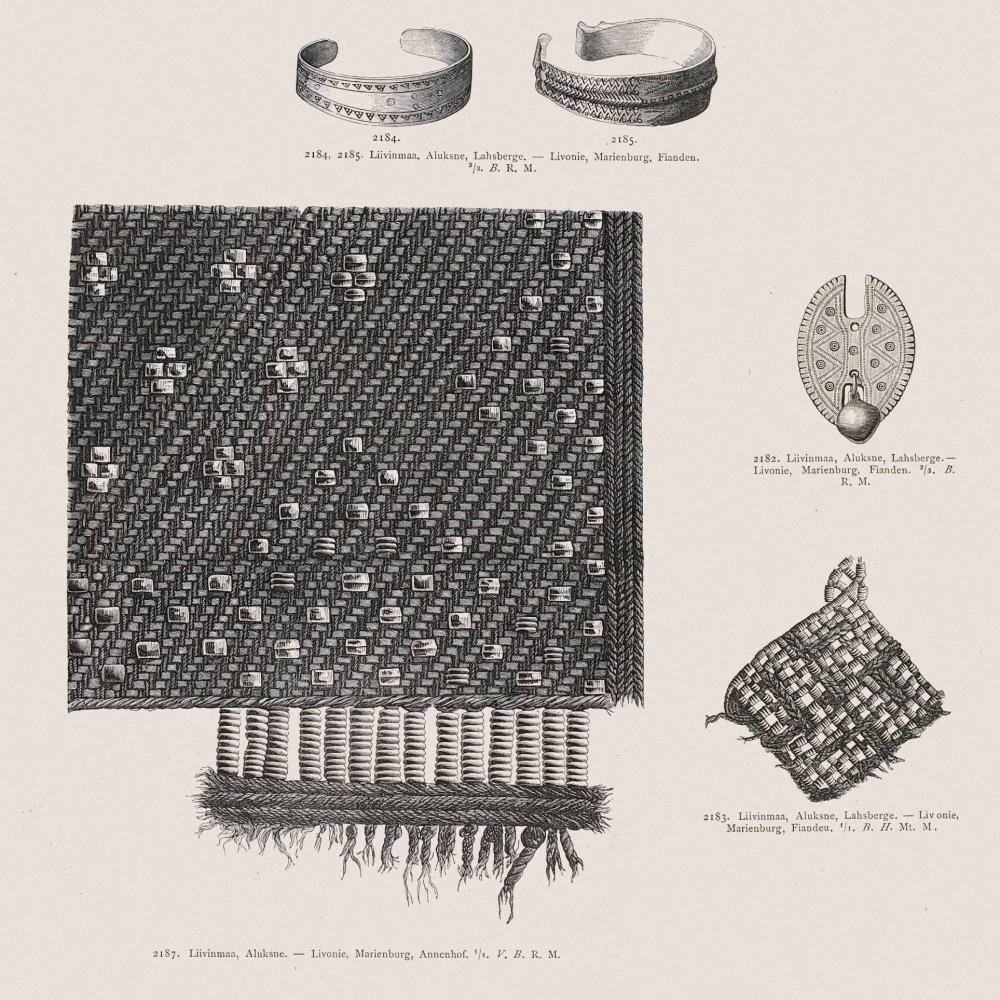
In 1884, several antiquities from the parishes of Lāzberģi (two bracelets and two pendants) and Anna (a shawl fragment) in the present-day Alūksne Municipality, found their way into the collection of the Cathedral Museum of the Riga Society of Researchers of History and Antiquities and were published in Volume 5 of the Finnish archaeologist Johannes Reinhold Aspelin’s work "Antiquités du Nord Finno-Ougrien". Aspelin is regarded as Finland’s first archaeologist and one of the founders of modern archaeology in Northern Europe. Aspelin was a participant in the national romantic movement and a proponent of various migration theories popular in the 19th century, including Matthias Castrén’s hypothesis regarding the Ural-Altaic language family. The version of the hypothesis espoused by Aspelin held that the Ural and Altai mountain regions were once inhabited by a singular Finno-Ugric people, whilst the lowlands had been flooded by the Biblical Great Flood. As early as the beginning of the 20th century, Aspelin’s theories were contested and refuted, yet even today his work and pioneering efforts in a new and, until then, virtually unexplored scientific discipline are held in high regard. Aspelin linked the artefacts found at Lāzberģi and Anna to the Livonian archaeological culture; however, from the perspective of modern archaeology, they should rather be associated with the Latgalian-Finno-Ugric zone of interaction, which encompasses the entire Alūksne district. Both of the Lāzberģis bracelets, for example, correspond to the Latgalian culture of the Late Iron Age (in Latvia, 9th–12th centuries) in Northern Vidzeme, yet similar ornaments are also found in the Finno-Ugric archaeological material from neighbouring Southern Estonia. A fragment of a shawl decorated with bronze strips is also distinctly Latgalian; judging by its ornamentation, it too dates to the Late Iron Age.
A few extraordinary finds are reported at the end of the century. As the newspaper "Baltijas Vēstnesis" tells it, the remains of a small vessel were discovered in Lake Alūksne during dredging work near Pilssala in 1895. The upper part of the vessel had reportedly largely decayed away, whilst the lower part, which had been submerged, was in better condition. The author of the article links the shipwreck to the period shortly before the fall of Alūksne Fortress in August 1702, when it was presumably hastily concealed in the reeds. The ship is not described in any further detail. The same article also mentions a clay pot found in Kolberģi parish whilst draining a bog, “filled with pieces of silver money” – in archaeological terms, a coin hoard. In total, the pot is claimed to have contained 1,246 coins, which the author presumes to date to the mid-16th century, although they provide no information to base this conclusion on. The pot was "handed over to the district chief for further decision", and this remains the first and last time that both of these finds are mentioned in writing.
Sources:
- Aspelin, Johannes Reinhold: Antiquités du Nord Finno-Ougrien. 5, L' âge du fer, Helsingfors: Endlund, 1884, Nr. 2812.-2815., 2817.
- Bienemann, Fr. (1911) Altlivlandische Erinnerungen - Reval, Verlag von Franz Kluge, 55.-57.lpp.
- Kreišmane, L. (sast.) Muiža pagasta rakstveža skatījumā. Rīga: Zinātne, 2017, 164.lpp.
- Valk, H., Laul, S.Siksälä : a community at the frontiers : Iron Age and Medieval. University of Tartu. Institute of History and Archaeology, Tallinn, 2007
- Vasks, A. (red.) Latvijas arheoloģijas rokasgrāmata, Rīga: LU Latvijas vēstures institūts, 2021. 95.lpp.
- Zariņa, A. Seno latgaļu apģērbs 7.-13. gs., Rīga: Zinātne, 1970. 72.-74.lpp.
- Aus dem Tagebuch eines Sentimentalen. Inland 1841. Nr.30, Sp.484
- J. R. Aspelin ja kansallisromantiikka. (n.d.). Csc.fi https://extras.csc.fi/arctinet/kivikaus/m7/7_6_3.htm
- Baltijas Vēstnesis, Nr.135 (17.06.1895)
Ieraksti meklēto